How to build , Manage and monitor your SQL Server replication


Hello my friends this my small post in SQL Server replication it is not everything about replication but at least it is the what any DBA should know it 11 Posts in SQL Server replication technology english and arabic posts

  • What is SQL Replication?
  • Types of SQL Replication
  • Replication Overview
  •  How to create Transaction Replication
  • How to Add New Publisher Server to the Distributor Server
  •  Disable Publishing and Distribution Servers
  • Publication Status
  • Subscription Status
  • Replication information for the Complete setup
  • Find publication article
  • How we can Check Distributor agent status
  • How we can Check log reader agent status

downloadreplica

All this previous point you can know it easily from the below Posts :

  1. Replication in SQL Server Part 1
  2. Replication in SQL Server Part 2
  3. Replication in SQL Server Part 3
  4. Replication in SQL Server Part 4
  5. SQL Server DMV Replication Monitoring Part 1
  6. SQL Server DMV Replication Monitoring Part 2
  7. SQL Server DMV Replication Monitoring Part 3
  8. SQL Server DMV Replication Monitoring Part 4
  9. الأكواد الديناميكية لمراقبة ومتابعة حلول تزامن البيانات 1/ 3
  10. الأكواد الديناميكية لمراقبة ومتابعة حلول تزامن البيانات 2/ 3
  11. الأكواد الديناميكية لمراقبة ومتابعة حلول تزامن البيانات 3/ 3

Follow me because i will do one online session in replication and i will enhance all this posts by adding lot of other information in replication .

To check all my posts you can direct to my personal website or you can download this Excel sheet My Technical POSTS

View all my tips , LinkedIn Website Slideshare ,Youtube Channel.

Where is index location on Database?


Where is index location on Database? 

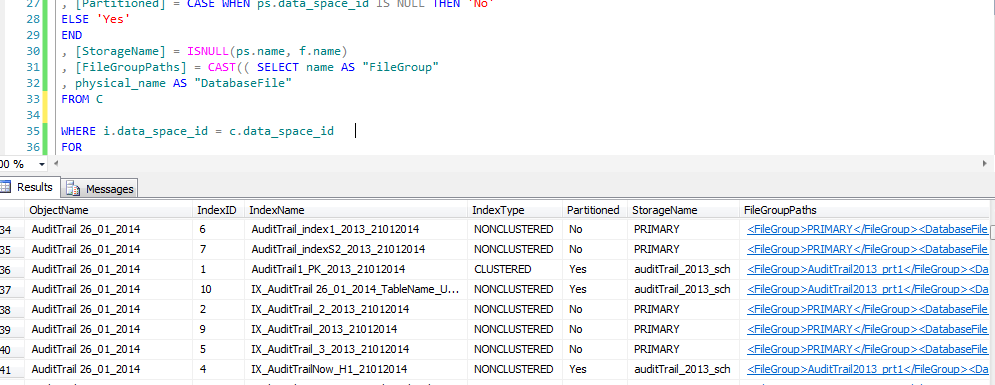
Hi guys today I will show smoothing is easy but more important to know about it {Where is the index live} by the below DMV we can return all the index with table name and with File group hosted on it , another thing you can use this DMV to know the heap tables , Clustered index , non-Clustered index

Index Location:

WITH C AS
(

SELECT ps.data_space_id
, f.name
, d.physical_name
FROM sys.filegroups f
JOIN sys.database_files d ON d.data_space_id = f.data_space_id
JOIN sys.destination_data_spaces dds ON dds.data_space_id = f.data_space_id
JOIN sys.partition_schemes ps ON ps.data_space_id = dds.partition_scheme_id

UNION

SELECT f.data_space_id
, f.name
, d.physical_name
FROM sys.filegroups f
JOIN sys.database_files d ON d.data_space_id = f.data_space_id
)
–SELECT * FROM c
SELECT [ObjectName] = OBJECT_NAME(i.[object_id])
, [IndexID] = i.[index_id]
, [IndexName] = i.[name]
, [IndexType] = i.[type_desc]
, [Partitioned] = CASE WHEN ps.data_space_id IS NULL THEN ‘No’
ELSE ‘Yes’
END
, [StorageName] = ISNULL(ps.name, f.name)
, [FileGroupPaths] = CAST(( SELECT name AS “FileGroup”
, physical_name AS “DatabaseFile”
FROM C

WHERE i.data_space_id = c.data_space_id
FOR
XML PATH(”)
) AS XML)
FROM [sys].[indexes] i
LEFT JOIN sys.partition_schemes ps ON ps.data_space_id = i.data_space_id
LEFT JOIN sys.filegroups f ON f.data_space_id = i.data_space_id
WHERE OBJECTPROPERTY(i.[object_id], ‘IsUserTable’) = 1
ORDER BY [ObjectName], [IndexName]

index

Follow me because next post I will explain everything about the index and How you can build you index model How you can Enhance your expensive query by index more Secrets in the index …ETC


How to Grant Show Plan Privilege


Showplan Privilege it’s granted for any one need to see the execution plane for SQL Server query to check the performance of the index or doing index analysis.

Grant Showplan for one user in one database  :

GRANT Showplan TO [DominName\username]

Grant Showplan for one user in All databases in one SQL instance:

 EXEC sp_MSforeachdb N’IF EXISTS
(
SELECT 1 FROM sys.databases WHERE name = ”?”
AND Is_read_only <> 1
)
BEGIN
print ”Use [?]; GRANT Showplan TO [DominName\username]”
END’;

after the execution take the Print scripts and run it in another session.

How to Check the last restart for DB Server


Hi Dears i received request from the developers by the Staging DB was down yesterday evening, between 6:00 PM to 9:00 PM, can you please advice at this time to do Scientific investigation and troubleshooting so at this time you should check 2 point :

  1. Last SQL Server instance restart.
  2. Last DB server (windows services ) restart.

Last SQL Server Restart :

we can check it easily and by the Easiest ways (SQL Query)

SELECT sqlserver_start_time FROM sys.dm_os_sys_info
SELECT ‘Statistics since: ‘ + CAST(sqlserver_start_time AS VARCHAR) FROM sys.dm_os_sys_info
Server Restart

Continue reading “How to Check the last restart for DB Server”

How to monitor your SQL Server instances..(2/10)?


in the previous post we Speaking about our idea for this Series of posts and i Started my First post with How to Diagnosis MSSQL Server or MSSQL Database with fast way ..? Today i will complete this part from How to Diagnosis  Your Database,

Database Information : in this Script we can cover this below points

  • How many databases are on the instance?
  • What recovery models are they using?
  • What is the log reuse wait description?
  • How full are the transaction logs ?
  • What compatibility level are they on?
  • What is the Page Verify Option?
  • Make sure auto_shrink and auto_close are not enabled!

SELECT db.[name] AS [Database Name], db.recovery_model_desc AS [Recovery Model],
db.log_reuse_wait_desc AS [Log Reuse Wait Description],
ls.cntr_value AS [Log Size (KB)], lu.cntr_value AS [Log Used (KB)],
CAST(CAST(lu.cntr_value AS FLOAT) / CAST(ls.cntr_value AS FLOAT)AS DECIMAL(18,2)) * 100 AS [Log Used %],
db.[compatibility_level] AS [DB Compatibility Level],
db.page_verify_option_desc AS [Page Verify Option], db.is_auto_create_stats_on, db.is_auto_update_stats_on,
db.is_auto_update_stats_async_on, db.is_parameterization_forced,
db.snapshot_isolation_state_desc, db.is_read_committed_snapshot_on,
db.is_auto_close_on, db.is_auto_shrink_on, db.target_recovery_time_in_seconds
FROM sys.databases AS db
INNER JOIN sys.dm_os_performance_counters AS lu
ON db.name = lu.instance_name
INNER JOIN sys.dm_os_performance_counters AS ls
ON db.name = ls.instance_name
WHERE lu.counter_name LIKE N’Log File(s) Used Size (KB)%’
AND ls.counter_name LIKE N’Log File(s) Size (KB)%’
AND ls.cntr_value > 0 OPTION (RECOMPILE);

Check Database File and all user database paths :

SELECT DB_NAME([database_id])AS [Database Name],
[file_id], name, physical_name, type_desc, state_desc,
CONVERT( bigint, size/128.0) AS [Total Size in MB]
FROM sys.master_files WITH (NOLOCK)
WHERE [database_id] > 4
AND [database_id] <> 32767
OR [database_id] = 2
ORDER BY DB_NAME([database_id]) OPTION (RECOMPILE);

How to Check the VLF count for All Databases:

CREATE TABLE #VLFInfo (RecoveryUnitID int, FileID int,
FileSize bigint, StartOffset bigint,
FSeqNo bigint, [Status] bigint,
Parity bigint, CreateLSN numeric(38));

CREATE TABLE #VLFCountResults(DatabaseName sysname, VLFCount int);

EXEC sp_MSforeachdb N’Use [?];

INSERT INTO #VLFInfo
EXEC sp_executesql N”DBCC LOGINFO([?])”;

INSERT INTO #VLFCountResults
SELECT DB_NAME(), COUNT(*)
FROM #VLFInfo;

TRUNCATE TABLE #VLFInfo;’

SELECT DatabaseName, VLFCount
FROM #VLFCountResults
ORDER BY VLFCount DESC;

DROP TABLE #VLFInfo;
DROP TABLE #VLFCountResults;


How to get CPU utilization by database :

WITH DB_CPU_Stats
AS
(SELECT DatabaseID, DB_Name(DatabaseID) AS [DatabaseName], SUM(total_worker_time) AS [CPU_Time_Ms]
FROM sys.dm_exec_query_stats AS qs
CROSS APPLY (SELECT CONVERT(int, value) AS [DatabaseID]
FROM sys.dm_exec_plan_attributes(qs.plan_handle)
WHERE attribute = N’dbid’) AS F_DB
GROUP BY DatabaseID)
SELECT ROW_NUMBER() OVER(ORDER BY [CPU_Time_Ms] DESC) AS [row_num],
DatabaseName, [CPU_Time_Ms],
CAST([CPU_Time_Ms] * 1.0 / SUM([CPU_Time_Ms]) OVER() * 100.0 AS DECIMAL(5, 2)) AS [CPUPercent]
FROM DB_CPU_Stats
WHERE DatabaseID > 4 — system databases
AND DatabaseID <> 32767 — ResourceDB
ORDER BY row_num OPTION (RECOMPILE);

Login_Name list with the Session Count:

SELECT login_name, COUNT(session_id) AS [session_count]
FROM sys.dm_exec_sessions WITH (NOLOCK)
GROUP BY login_name
ORDER BY COUNT(session_id) DESC OPTION (RECOMPILE);

Check Adhoc Query:

SELECT TOP(20) [text] AS [QueryText], cp.size_in_bytes
FROM sys.dm_exec_cached_plans AS cp WITH (NOLOCK)
CROSS APPLY sys.dm_exec_sql_text(plan_handle)
WHERE cp.cacheobjtype = N’Compiled Plan’
AND cp.objtype = N’Adhoc’
AND cp.usecounts = 1
ORDER BY cp.size_in_bytes DESC OPTION (RECOMPILE)

Top Cash quires by Execution count :

SELECT TOP (250) qs.execution_count, qs.total_rows, qs.last_rows, qs.min_rows, qs.max_rows,
qs.last_elapsed_time, qs.min_elapsed_time, qs.max_elapsed_time,
total_worker_time, total_logical_reads, 
SUBSTRING(qt.TEXT,qs.statement_start_offset/2 +1,
(CASE WHEN qs.statement_end_offset = -1
			THEN LEN(CONVERT(NVARCHAR(MAX), qt.TEXT)) * 2
	  ELSE qs.statement_end_offset END - qs.statement_start_offset)/2) AS query_text 
FROM sys.dm_exec_query_stats AS qs WITH (NOLOCK)
CROSS APPLY sys.dm_exec_sql_text(qs.sql_handle) AS qt
ORDER BY qs.execution_count DESC OPTION (RECOMPILE);

this not the end i have lot of Scripts can help us to figure the most repeated issue in SQL Server so if you need to know the more Follow me in the Next Post