
History of all Committed DDL Statement Executions


Now if i need to Make Auditing in my SQL Server production to know any thing happens in my SQL Server  We have 3 Ways :

1- We can Use third party tool like this one for free

http://www.toadworld.com/KNOWLEDGE/ToadKnowledge/TipsandTricks/tabid/74/TID/303/cid/38/Default.aspx

2- use SQl Server Report to Audit your SQL Server . it Will give you Summary about the Object Changed like Create , Drop , Alter .

3- Use SQL Server Audit Feature . Under Security  in SQL Server SSMS . it can give you any info you need to know it.

I will Explain today the How to check the History of all Committed DDL Statement by SQL Server Reports.

in the first i will create table to Explain my Examples on it

Create Database Audit

go

use Audit

GO

SET ANSI_NULLS ON
GO

SET QUOTED_IDENTIFIER ON
GO

CREATE TABLE [dbo].[TABLEAUDIT](
[EMP_ID] [int] IDENTITY(1,1) NOT NULL,
[EMP_NAME] [nvarchar](50) NULL,
[EMP_SALARY] [bigint] NULL,
[EMP_BOUNS] [bigint] NULL,
[TOTAL_SALARY] AS ([EMP_SALARY]+[EMP_BOUNS]),
[EMP_ADDRESS] [nvarchar](100) NULL,
CONSTRAINT [PK_TABLEAUDIT] PRIMARY KEY CLUSTERED
(
[EMP_ID] ASC
)WITH (PAD_INDEX = OFF, STATISTICS_NORECOMPUTE = OFF, IGNORE_DUP_KEY = OFF, ALLOW_ROW_LOCKS = ON, ALLOW_PAGE_LOCKS = ON) ON [PRIMARY]
) ON [PRIMARY]

GO

then now i will insert Data :

—INSERT DATA
INSERT INTO TABLEAUDIT ([EMP_NAME],[EMP_SALARY],[EMP_BOUNS],[EMP_ADDRESS])
VALUES
(‘Mostafa’,2500,500,’Egypt-Cairo-Helwan’)
, (‘M.Osman’,3000,500,’Egypt-Alex’)
, (‘M.Omar’,3000,500,’Egypt-Assuit’)
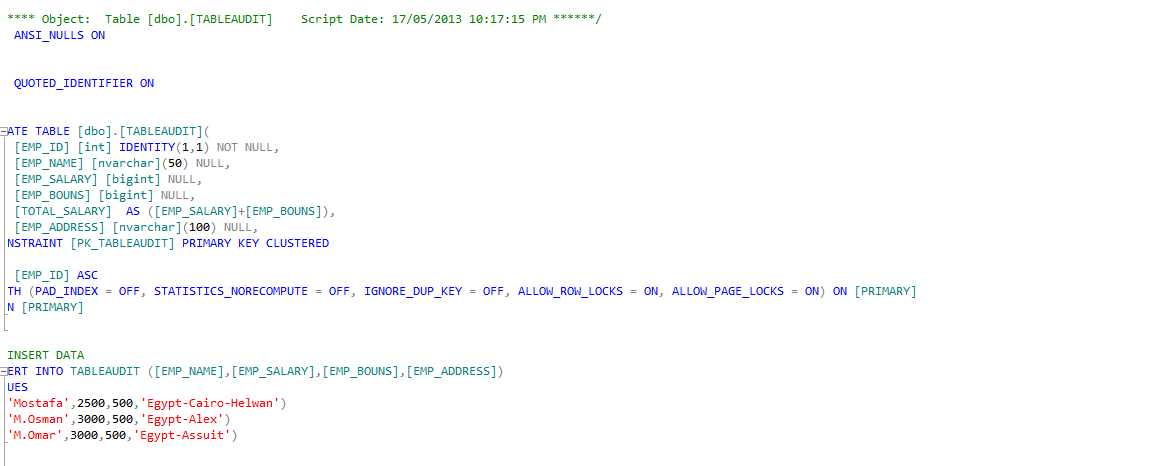
Create Example

SQL Server Reports to Audit your SQL production :

1- Schema Changes History Reports

Open SSMS >>> Database Audit >>>> Right Click on it >>>> Reports >>>> Stander Reports >>>> Schema Changes History Report .

you will see the Changes happens in database Audit but only in the Create and Alter and if you make and Drop to Column , table , View Like this you can reviwe it by the time and How make this action from this report on this database

Schema Changes History Report

also you can check any changes happens in your server on all database_user by this steps :

Open SSMS >>>> Connect to your instance you need to make audit on it >>>> right click on your server name >>>> Reports >>>> Stander Reports >>>> Schema Changes History report .

Schema Changes History Report On Server

so now we can know a history of all Committed DDL Statement Executions Recorded. but not give us all info like the DML Statement Executions.

DBA Check List


Any DBA must now :

How to become As DBA ?

What is General DBA Best Practices ?

What DBA do Day-to-Day

And more tips like Installation , Upgrade , maintenance , performance , High Availibilty , and other Services (SSIS,SSAS,SSRS)

So if you need to know more about this Check this Link is very useful to any DBA (SQL Server , Or Oracle )

https://www.simple-talk.com/sql/database-administration/brads-sure-dba-checklist/

How Can i Create index on Non-Deterministic Column in SQL Server


Question 1 :

How Can i Create index on Non-Deterministic Column in table or View ?

Answer :

I can’t Create Index on Non-Deterministic Column in table or View because this is the limitation of the index .

Question 2 :

What is the Deterministic and Non-Deterministic Function in SQL Server ?

Answer :

These built-in functions from categories of built-in functions other than aggregate and string functions are always deterministic:

ABS DATEDIFF PARSENAME
ACOS DAY POWER
ASIN DEGREES RADIANS
ATAN EXP ROUND
ATN2 FLOOR SIGN
CEILING ISNULL SIN
COALESCE ISNUMERIC SQUARE
COS LOG SQRT
COT LOG10 TAN
DATALENGTH MONTH YEAR
DATEADD NULLIF

These built-in functions from other categories are always nondeterministic:

@@ERROR FORMATMESSAGE NEWID
@@IDENTITY GETANSINULL PATINDEX
@@ROWCOUNT GETDATE PERMISSIONS
@@TRANCOUNT GetUTCDate SESSION_USER
APP_NAME HOST_ID STATS_DATE
CHARINDEX HOST_NAME SYSTEM_USER
CURRENT_TIMESTAMP IDENT_INCR TEXTPTR
CURRENT_USER IDENT_SEED TEXTVALID
DATENAME IDENTITY USER_NAME

to know more information about this Check this link Check this Link

http://msdn.microsoft.com/en-us/library/aa214775(v=sql.80).aspx

Question 3 :

How can i check the Column is deterministic or deterministic ?

Answer :

you can check this by retrieving the Column properties with COLUMNPROPERTY .

LIKE :

Select COLUMNPROPERTY (OBJECT_ID( ‘Table_Name‘ ), ‘Column_Name‘, ‘IsDeterministic‘);

the result return from this Select Statement one of them :

1 = TRUE
0 = FALSE
NULL = Input is not valid. Not a computed column or view column.

Note : You can Change the value of  ‘IsDeterministic‘ to another value like (‘IsIndexable‘,’IsComputed‘)

to know more about this values Check this link

http://www.mssqltips.com/sqlservertip/1298/retrieving-sql-server-column-properties-with-columnproperty/

Example :

—Create Table name Computed_Col

CREATE TABLE [dbo].[Computed_Cal](
[ID] [int] NULL,
[Sallary] [bigint] NULL,
[Bouns] [bigint] NULL,
[Date] [datetime] NULL,
[Total] AS ([Sallary]+[Bouns]),
[ADDDATE] AS (dateadd(day,(20),[Date])),
[returndate] AS (getdate()),
[Calc_Year] AS (DATENAME(YEAR,[DATE]))
) ON [PRIMARY]

—-Insert Data

SET DATEFORMAT DMY
INSERT INTO Computed_Cal (ID,SALLARY,BOUNS,[DATE])
VALUES (1,2500,500,’16-05-2013′)

Computed_Cal

now i created 4 Computed Column (Total,ADDDATE,returndate,Calc_Year)

if you select * from this table you will find the Column Working good but the Question what will happened when i try to Create index on this Columns let’s see i will Create 2 index one in Column name (ADDDATE) and one in (returndate)

—-Create Index on Column name (ADD_DATE) :

CREATE NONCLUSTERED INDEX ind2_ADD_DATE
ON Computed_Cal ([ADD_DATE]);
GO

the index created Successfully because this column not NonDeterministic Column Meaning i don’t use NonDeterministic Function in the Computed Formula

now i will Check the Column property for column name ADDDATE to know IsDeterministic and IsIndexable if the result is (( 1 )) its will Accept the index and it not have any function form NonDeterministic Function the If it (( 0 )) it will not Accept like we will see in another Creating index

—CHECK THE COLUMNPROPERTY
SELECT COLUMNPROPERTY (OBJECT_ID(‘Computed_Cal’), ‘ADDDATE’, ‘IsDeterministic’);
SELECT COLUMNPROPERTY (OBJECT_ID(‘Computed_Cal’), ‘ADDDATE’, ‘IsIndexable’);

Check Columnproperty

—-Create Index on Column name (returndate) :

in this Column if you check the formula you will see i select to getdate() Function to retrieve the time of the insert data  in this Function is one form the NonDeterministic Function .

At the First i will Check the COLUMNPROPERTY for this column (returndate):

—CHECK THE COLUMNPROPERTY
SELECT COLUMNPROPERTY (OBJECT_ID(‘Computed_Cal’), ‘returndate’, ‘IsDeterministic’);
SELECT COLUMNPROPERTY (OBJECT_ID(‘Computed_Cal’), ‘returndate’, ‘IsIndexable’);

Result is 0 so it meaning this Column have NonDeterministic Function and it will not Accept index .

NonDeterministic

Now i f  i try to Crate This Index on this Column :

— index 2

CREATE NONCLUSTERED INDEX ind3_return_date
ON Computed_Cal (returndate);
GO

SQl Serve will give me Error:

Msg 2729, Level 16, State 1, Line 3
Column ‘returndate’ in table ‘Computed_Cal’ cannot be used in an index or statistics or as a partition key because it is non-deterministic.

Non-Determimistic2

In the Finally we must be take care when we build the table Structure 

Eng.Mostafa Elmasry

Database Administrator

SQL Server Configuration Manger Error


Today i face error when i need to check my SQL Server Configuration manger for SQL Server 2008R2 Sp1 When the SQL Server Services “Remote Procedure Call Failed”

Error :

SQLConfig Error


How to Fix this Error ?

I try more salutation but the best one of them is “Upgrade SQL Server Services from SP1 to SP2” after i run this update this error is go out to download this Update go to this link

http://www.microsoft.com/en-us/download/details.aspx?id=30437


Replicate Function in SQL Server 2012


This New function in SQl Server 2012  (Replicate)

it repeats the string/character expression N number of times specified in the function.


Example :

DECLARE @FirstString nVARCHAR(MAX)
SET @FirstString = REPLICATE(‘A’,12000)
Select @FirstString
SELECT LEN(@FirstString) LenFirstString;

Replicate Function


Now we see the Result of character”A” it’s repeated but the Question

Why when i Select the Len the result is 8000 not 12000 ?